

MagQu
Phosphorylated Tau protein [pT217] IMR Reagent
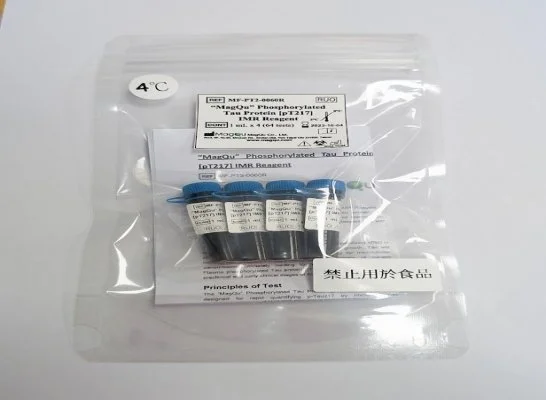
“MagQu” Phosphorylated Tau protein [pT217] IMR Reagent is used to quantitatively measure phosphorylated Tau protein(p-Tau217) in human fluid specimen, such as plasma, serum or CSF.
Use “MagQu” Phosphorylated Tau protein [pT217] IMR Reagent only with the XacPro-S System (MagQu Co., Ltd.).
Tau protein is a microtubule-associated protein and is abundant in nervous system. Tau protein can maintain the structure of neuron cells and support the transport of substance. When tau proteins phosphorylated, It will result in the self-assembly of tangles in brain and increased some neurodegenerative diseasesincluding Alzheimer’s disease (AD)、Pick's disease、Parkinson's disease (PD)、Progressive supranuclear palsy(PSP) and Corticobasal degeneration (CBD). Plasma phosphorylated Tau protein 217 (p-Tau217) increased in the preclinical and early clinical stages of Alzheimer’s disease.1,2
“MagQu” Phosphorylated Tau protein [pT217] IMR Reagent is designed for rapid quantifying phosphorylated Tau protein(p-Tau217) by Immuno Magnetic Reduction (IMR). We conjugated the antibody on the surface of around 50 nm-in-diameter Fe3O4 magnetic particles. When the antibodies on the surface bind with phosphorylated Tau protein (p-Tau217), the magnetic particles form clusters. Therefore, the ac susceptibility (Xac) of magnetic particles would be reduced in the adding ac magnetic field. By measuring the reduction of Xac, we can quantify phosphorylated Tau protein(p-Tau181) in the sample easily, rapidly, and accurately.
Features
Quantify phosphorylated Tau protein (p-Tau217) in the sample easily, rapidly, and accurately
Magnetic Nanoparticle
Dextran layer
For Alzheimer’s disease research use
ImmunoMagnetic Reduction (IMR)
Specifications
Core: Iron Oxide (Fe3O4)
Layer: Dextran
Surface protein: Anti-phosphorylated Tau protein(p-Tau217) antibody
Mean Diameter of Particles: 50 ~ 60 nm
The analytical range of reagent: 0.1 to 100 pg/mL phosphorylated Tau protein(p-Tau217)
Buffer: ddH2O
Storage temp.: 2 ~ 8 ℃
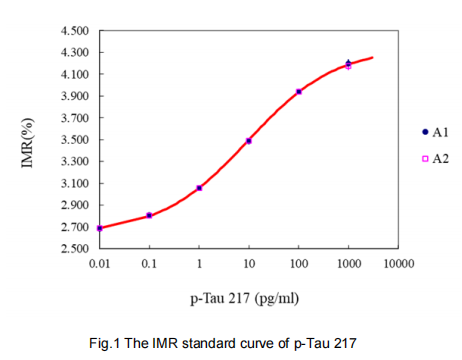
The analytical range of reagent is from 0.1to 100pg/mL. When the specimen with p-Tau217>100 pg/mL is to be determined, carry out the following procedures to obtain the accurate concentration. Dilute the specimen, re-assay, and multiply the assayed p-Tau217 value by the dilution factor.Reagents should be used before the expiration date printed on the kit label. Data is based upon human plasma sample. Do not use the plasma sample when it has left-20oCmore than 2 hours or it has something precipitated. Glass testing tubes are single use only.
Clinical Performance
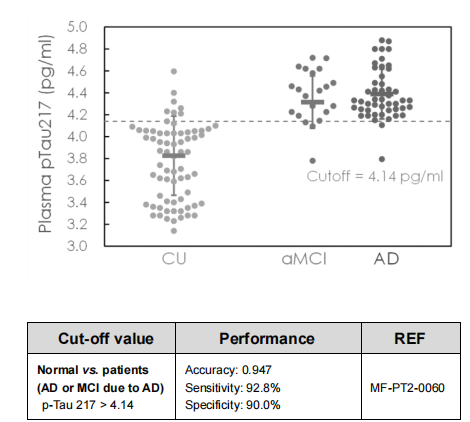
Plasma samples from normal controls (NC, n = 70),patients with mild cognition impairment (MCI, n =21) and patients withAlzheimer’s disease (AD, n = 48) were collected for p-Tau 217 assays using the p-Tau 217 reagent.The higher the value, the higher the probability of Alzheimer's disease.Using this product, if the test value of the subject p-Tau 217> 4.14 (Accuracyis 0.947), it is recommended to visit the relevant specialist for further Alzheimer's disease examination.
Description
Tau protein is a microtubule-associated protein and is abundant in nervous system. Tau protein can maintain the structure of neuron cells and support the transport of substance. When tau proteins phosphorylated, It will result in the self-assembly of tangles in brain and increased some neurodegenerative diseasesincluding Alzheimer’s disease (AD)、Pick's disease、Parkinson's disease (PD)、Progressive supranuclear palsy(PSP) and Corticobasal degeneration (CBD). Plasma phosphorylated Tau protein 217 (p-Tau217) increased in the preclinical and early clinical stages of Alzheimer’s disease.
Selected References
1.Suárez-Calvet M, Karikari TK, Ashton NJ, Lantero Rodríguez J, Milà-Alomà M, Gispert JD, Salvadó G, Minguillon C, Fauria K, Shekari M, Grau-Rivera O, Arenaza- Urquijo EM, Sala-Vila A, Sánchez-Benavides G, González-de-Echávarri JM, Kollmorgen G, Stoops E, Vanmechelen E, Zetterberg H, Blennow K, Molinuevo JL; ALFA Study. Novel tau biomarkers phosphorylated at T181, T217 or T231 rise in the initial stages of the preclinical Alzheimer's continuum when only subtle changes in Aβ pathology are detected. EMBO Mol Med. 2020 Dec 7;12(12):e12921.
2.Yang SY, Chiu MJ, Chen TF, Horng HE. Detection of Plasma Biomarkers Using Immunomagnetic Reduction: A Promising Method for the Early Diagnosis of Alzheimer's Disease. Neurol Ther. 2017 Jul;6(Suppl 1):37-56.
3.Yang CC, Yang SY, Ho CS, Chang JF, Liu BH, Huang KW. Development of antibody functionalized magnetic nanoparticles for the immunoassay of carcinoembryonic antigen: a feasibility study for clinical use. J Nanobiotechnology. 2014 Nov 26;12:44
Applications
Quantitative detection for ultra-low-concentration bio-molecules, e.g. Alzheimer's-disease bio-markers in blood.
